Zum Inhalt springen
  • Blog
  • Cookie Policy (EU)
  • Datenschutzerklärung
  • EBF Docs
  • Onboarder Source and Target
  • Test
  • EBF product documentation

    Find help using and administering EBF applications

    EBF Files

    • Release Notes
    • 01. What is EBF Files
    • 02. Requirements and Configuration
    • 03. Get EBF Files up and running in few steps
    • 04. App usage by end user
    • 05. Limitations
    • 06. Contact
    View Categories
    • Home
    • EBF Docs
    • EBF Files

    05. Limitations

    2 min read

    5.1 Restrictions for folders and files (SMB)

    EBF Files limitations primarily apply to the handling of directories and files within the server and corresponding application. For example, Microsoft Windows file restrictions apply to file operations within the application which are manifested in any respective containers.

    • Directory and file names are not case sensitive
    • Directory and file component names must not be longer than 255 characters
    • Directory names cannot end with slash (/). If specified, it will be removed automatically
    • File names cannot end with slash (/)
    • Reserved URL characters must be encoded
    • The following characters are not allowed: “ \ / : | < > * ?

    Invalid URL path characters are not allowed. Codes like \uE000 are valid in NTFS filenames, but not other Unicode characters. For example control characters (0x00 to 0x1F, \u0081, etc.) are not allowed. For the rules for Unicode strings in HTTP/1.1, see RFC 2616, Section 2.2: Basic Rules and RFC 3987

    The following file names referencing ports and destinations are not allowed: LPT1, LPT2, LPT3, LPT4, LPT5, LPT6, LPT7, LPT8, LPT9, COM1, COM2, COM3, COM4, COM5, COM6, COM7, COM8, COM9, PRN, AUX, NUL, CON, CLOCK$, dot (.), two dots (..)

    5.2 Restrictions for working with files on SharePoint On-Premise

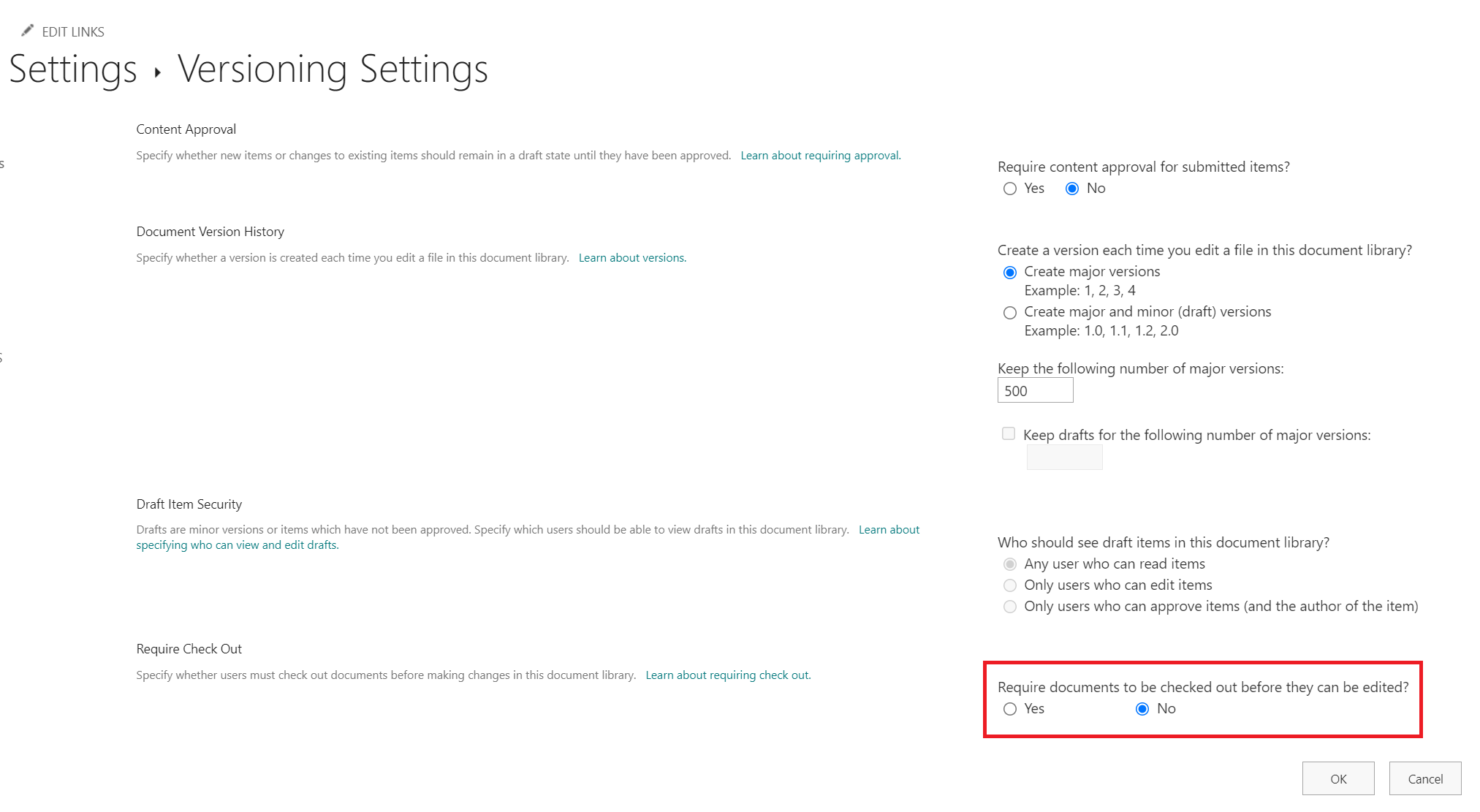
    For EBF Files accessing SharePoint files it is necessary, that library settings for each site are set to not require a checkout before editing.
    This settings can be found in the site’s document library settings in the versioning page as shown below:
    5.3 Supported file extensions

    EBF Files supports a limited set of extension types that can be opened/viewed and edited:

    • MsWord (.doc,…)
    • MsExcel (.xls, …)
    • MsPowerPoint (.ppt,…)
    • Pdf (.pdf)
    • Audio (wide range of audio file extensions): Compatibility depends on the supported codecs of the OS.
    • Image (wide range of image file extensions): Compatibility depends on the supported codecs of the OS.
    • Text (.txt)
    • Video (MOV, MP4): Compatibility depends on the supported codecs of the OS.

    All other file types are shown in the file list but can not be opened.

    Was this article useful?

    Still stuck? How can we help?

    How can we help?

    Updated on 29. August 2024
    04. App usage by end user06. Contact
    Table of Contents
    • 5.1 Restrictions for folders and files (SMB)
    • 5.2 Restrictions for working with files on SharePoint On-Premise
    • 5.3 Supported file extensions
    Linkedin-in Phone
    Workplace Management
    • UEM Solutions
    • Migrations
    • Services
    Modern Work Tools
    • Sync Contacts
    • Hybrid Data Management
    • Secure Mobile Printing
    • eSIM Management
    • App Management
    IT Security
    • IAM
    • Modern Threat Defense
    • Cyber Risk Management
    • Secure Development
    • Zero Trust
    • Security Check
    AI Solutions
    • AI Consulting
    • AI Development
    Company
    • About Us
    • References
    • Partners
    • Sustainability
    • Careers
    • Trends
    © 2026 EBF-EDV Beratung Föllmer GmbH
    • Privacy Policy
    • GTC
    • EULA
    • Imprint
    Manage Consent
    To provide the best experiences, we use technologies like cookies to store and/or access device information. Consenting to these technologies will allow us to process data such as browsing behavior or unique IDs on this site. Not consenting or withdrawing consent, may adversely affect certain features and functions.
    Functional Immer aktiv
    The technical storage or access is strictly necessary for the legitimate purpose of enabling the use of a specific service explicitly requested by the subscriber or user, or for the sole purpose of carrying out the transmission of a communication over an electronic communications network.
    Preferences
    The technical storage or access is necessary for the legitimate purpose of storing preferences that are not requested by the subscriber or user.
    Statistics
    The technical storage or access that is used exclusively for statistical purposes. The technical storage or access that is used exclusively for anonymous statistical purposes. Without a subpoena, voluntary compliance on the part of your Internet Service Provider, or additional records from a third party, information stored or retrieved for this purpose alone cannot usually be used to identify you.
    Marketing
    The technical storage or access is required to create user profiles to send advertising, or to track the user on a website or across several websites for similar marketing purposes.
    • Optionen verwalten
    • Dienste verwalten
    • Verwalten von {vendor_count}-Lieferanten
    • Lese mehr über diese Zwecke
    View preferences
    • {title}
    • {title}
    • {title}
    EBF Status Check