Zum Inhalt springen
  • Blog
  • Cookie Policy (EU)
  • Datenschutzerklärung
  • EBF Docs
  • Onboarder Source and Target
  • Test
  • EBF product documentation

    Find help using and administering EBF applications

    EBF Print

    • Release Notes
    • 01. Getting Started
    • 02. Architecture and Workflow
    • 03. Requirements
    • 04. Initial Installation
    • 05. Configuration
    • 06. Contact
    View Categories
    • Home
    • EBF Docs
    • EBF Print

    04. Initial Installation

    2 min read

    Since the Print Proxy System and the Print Server System are functionally interdependent, there is no need to follow an installation sequence.

    First, the EBF appliance in the EBF Print version must be installed on all participating systems. Afterwards, the respective service version (Print Proxy, Print Proxy Admin Portal and Print Server) is configured.

    Installation with ISO Appliance

    This section describes how to install an EBF appliance as a virtual system based on an ISO image.

    1. Configure a virtual machine according to the specifications in 02.1. Please note, that the VM must be configured for CentOS 7 x64 Linux operating system.
    2. Next the EBF ISO image is assigned to the created VM shell as start medium.
    3. Start the VM based on the ISO as start medium.
    4. When booting from Linux, the following installation menu appears:
    5. Select the desired installation language and click „Next“ to display the „Installation Summary“ menu:
    6. Configure optional settings, such as Date/Time (New York time/EST is default) and keyboard language. When using a German keyboard, the German language layout should be added):
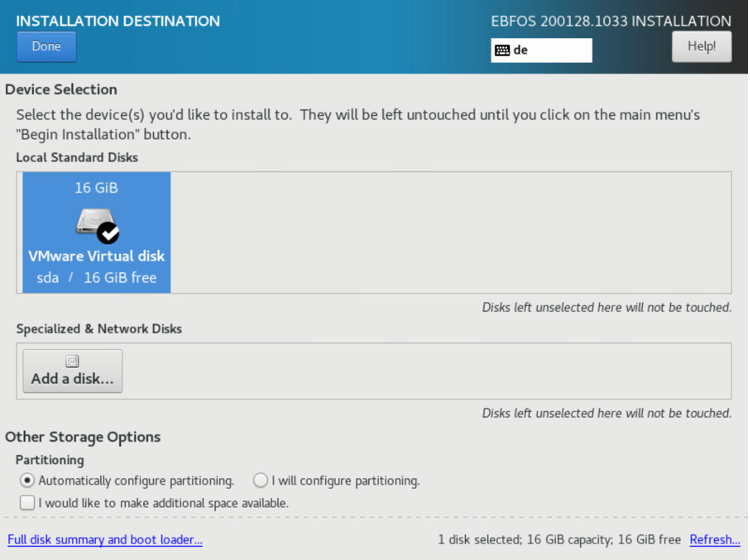
    7. Under “Installation Summary” > “System” > “Installation Destination”, select the local drive where the software will be installed. It is enough to select the main drive and click on „Done“.
    8. Under “Installation Overview” > “Software” > “Software Selection”, select the packages to be installed:
    9. After „EBF Print“ has been selected, agree to the installation by clicking „Done“. The next screen starts the installation:
    10. Set the password for the user root.
    11. After installation a reboot is required.
    12. Log in as root in the bash terminal of the system with previously set root password.
    13. The ISO image can now be ejected from the virtual machine.
    14. After completion check:
      • the connectivity of the computer and access over SSH
      • the availability of the computer available externally
      • the availability of updates for any packages

    When in doubt, contact your network administrator. Network configuration can be further adjusted from within the EBFOS ISO installation image.


    Was this article useful?

    Still stuck? How can we help?

    How can we help?

    Updated on 21. Mai 2021
    03. Requirements05. Configuration
    Table of Contents
    • Installation with ISO Appliance
    Linkedin-in Phone
    Workplace Management
    • UEM Solutions
    • Migrations
    • Services
    Modern Work Tools
    • Sync Contacts
    • Hybrid Data Management
    • Secure Mobile Printing
    • eSIM Management
    • App Management
    IT Security
    • IAM
    • Modern Threat Defense
    • Cyber Risk Management
    • Secure Development
    • Zero Trust
    • Security Check
    AI Solutions
    • AI Consulting
    • AI Development
    Company
    • About Us
    • References
    • Partners
    • Sustainability
    • Careers
    • Trends
    © 2026 EBF-EDV Beratung Föllmer GmbH
    • Privacy Policy
    • GTC
    • EULA
    • Imprint
    Manage Consent
    To provide the best experiences, we use technologies like cookies to store and/or access device information. Consenting to these technologies will allow us to process data such as browsing behavior or unique IDs on this site. Not consenting or withdrawing consent, may adversely affect certain features and functions.
    Functional Immer aktiv
    The technical storage or access is strictly necessary for the legitimate purpose of enabling the use of a specific service explicitly requested by the subscriber or user, or for the sole purpose of carrying out the transmission of a communication over an electronic communications network.
    Preferences
    The technical storage or access is necessary for the legitimate purpose of storing preferences that are not requested by the subscriber or user.
    Statistics
    The technical storage or access that is used exclusively for statistical purposes. The technical storage or access that is used exclusively for anonymous statistical purposes. Without a subpoena, voluntary compliance on the part of your Internet Service Provider, or additional records from a third party, information stored or retrieved for this purpose alone cannot usually be used to identify you.
    Marketing
    The technical storage or access is required to create user profiles to send advertising, or to track the user on a website or across several websites for similar marketing purposes.
    • Optionen verwalten
    • Dienste verwalten
    • Verwalten von {vendor_count}-Lieferanten
    • Lese mehr über diese Zwecke
    View preferences
    • {title}
    • {title}
    • {title}
    EBF Status Check